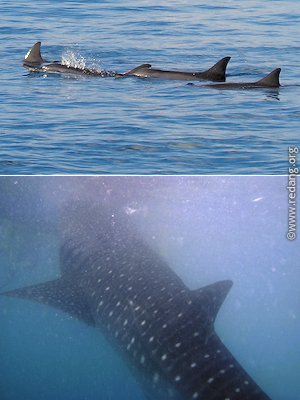
Dolphins and whale sharks are protected in Malaysian waters.
In Malaysia, certain terrestrial wildlife species are classified as 'totally protected' or 'protected' by federal legislation under the Malaysian Wildlife Conservation Act 2010. The act covers hunting, fishing, capturing and trading, illegal research and study, anti-cruelty clauses as well as requirements for zoo management. Some of these protected species can be found on Redang island and include the long-tailed macaque monkeys, the tokay gecko and the Malayan green whip snake.
All marine mammals and turtles are protected in Malaysian waters by federal laws and certain state laws, which apply within a 200 nautical mile Exclusive Economic Zone (EEZ). These aquatic mammals include whales, dolphins and dugongs. Additionally, whale sharks, the largest fish in the ocean, are also protected in Malaysian waters.
Wildlife conservation and protection is necessary to prevent the extinction of many endangered animal species. Uncontrolled harvesting, hunting and capturing of these species for food, collection or trade, destruction of their natural habitats and food sources have meant the number of animals remaining are so few that they cannot reproduce sufficiently quickly to recover. A species is considered endangered if it appears on an official list such as the IUCN (International Union for Conservation of Nature) Red List, the CITES (Convention on International Trade in Endangered Species) Appendix, or the US-ESA (U.S. Endangered Species Act) Endangered Species list. It's possible for the status of a species to change, to become critically endangered if numbers drop below a certain threshold or drop out of the endangered list completely when their numbers increase sufficiently.
The IUCN Red List defines species as Critically Endangered (extremely high risk of extinction), Endangered (very high risk of extinction) or Vulnerable (high risk of extinction) if it meets any of the quantitative criteria A-E as follows:
| Criteria | Critical (CR) | Endangered (EN) | Vulnerable (VU) |
|---|---|---|---|
| A | Population reduction of ≥90% (A1) or ≥80% (A2) | Population reduction of ≥70% (A1) or ≥50% (A2) | Population reduction of ≥50% (A1) or ≥30% (A2) |
| B | Extent ≤100km² Area ≤10km² |
Extent ≤5000km² Area ≤500km² |
Extent ≤20000km² Area ≤2000km² |
| C | Population size ≤250 | Population size ≤2500 | Population size ≤10000 |
| D | Population size ≤50 | Population size ≤250 | Population size ≤1000 |
| E | Probability of extinction in the wild ≥50% | Probability of extinction in the wild ≥20% | Probability of extinction in the wild ≥10% |
- Population reduction over the last 10 years or 3 generations, whichever is longer: (A1) Causes of reduction are clearly reversible, understood and ceased, (A2) Causes not understood/reversible/ceased. (A2) also includes reduction within the next 10 years or 3 generations, whichever is longer (up to 100 years) or reduction over any 10-year or 3-generation period that includes past and future.
- Geographic range in terms of Extent of occurrence and/or Area of occupancy
- Population size of mature individuals AND an estimated continuing decline of at least 25% within 3 years or 1 generation, whichever is longer (up to 100 years in the future)
- Population size of mature individuals
- Quantitative analysis showing the probability of extinction in the wild within 10 years or 3 generations, whichever is longer (up to 100 years max.)
For more information, please refer to IUCN Red List Categories and Criteria v3.1
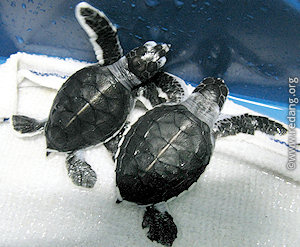
Baby green turtles are hatched naturally in Redang and returned to the sea.
It's quite common to spot a turtle in Redang. When you do, chances are it is most likely a Green or Hawksbill turtle (see the turtle identification page to lean how to recognize them). One study showed that out of a total of 7072 nests recorded at Chagar Hutang Turtle Sanctuary on Redang from 1993 to 2008, 98% were green turtle nests while only 2% were hawksbill nests. Of the 7 species of marine turtles in the world (all of which are classified as vulnerable, endangered or critically endangered according to the IUCN Red List of Threatened Species), 4 species used to come ashore and lay their eggs on Malaysian beaches. These were the Leatherback turtle, Hawksbill turtle, Green turtle and Olive Ridley turtle. The Leatherback and Hawksbill are considered critically endangered, while Green turtles are endangered and Olive Ridleys are vulnerable.
According to Dr.Chan Eng Heng, CEO of Turtle Conservation Centre in Terengganu, Malaysia, data gathered on turtle nestings in Terengganu beaches in 2010 showed that the Leatherback and Olive Ridley turtles have effectively disappeared with fewer than 5 nests per year. Even Hawksbill turtles nestings have plummeted to fewer than 20 nests per year. Only Green turtles continued to nest in any significant number with over 2000 nests per year but this still represented a 25% decline over the last 20 years.
Among the key reasons for their decline are over-harvesting and consumption of turtle eggs, destruction of their coastal habitats and nesting areas due to development, commercial fishing and poaching of turtles and inadequate protection laws and enforcement.
Now, if you eat turtle eggs, you're probably thinking that eating a few eggs can't hurt since turtles lay so many eggs. Fact is, turtles lay a lot of eggs to increase their chances of survival. Many perish along the way. Eggs are dug up and eaten by animals like monitor lizards. Newborn hatchlings are preyed upon by birds, terrestrial animals and ocean predators. The remaining survivors face threats from fishing and poaching activities. It is estimated that only 1 in every 1000 or more hatchlings survive long enough to mature and return to nest, a process which can take anywhere between 15-30 years. Their strategy for survival as a species depends on many being hatched in the hope that a few will live long enough to continue their cycle of life. So stop eating turtle eggs and you will give turtles a higher chance of survival.
 Save our turtles!
- Don't eat turtle eggs. Reducing demand reduces collection and sale of eggs.
- Preserve their habitats such as nesting beaches, seagrass beds and coral reefs.
- Avoid the use of fishing nets that can drown turtles caught in them. Remove discarded nets from the sea.
- Dispose litter properly by placing them in rubbish bins. Remove plastic bags and litter from the sea so that turtles do not consume them.
- Don't harass nesting turtles. Remove bright lights from nesting areas as these discourage turtles from coming ashore and disorient hatchlings.
Marine turtles are highly migratory ocean-going reptiles. Turtles may swim out of protected areas across maritime borders into unprotected areas where they fall prey to fishermen or poachers. Some drown or die accidentally when they are caught in fishing nets or eat litter like plastic bags. What is required are trans-frontier protection zones like the Turtle Islands Heritage Protected Area (TIHPA) at the Philippines-Sabah Turtle Islands group, the world's first trans-frontier protected area for sea turtles. The TIHPA is jointly managed by both Malaysia and Philippines and seeks to conserve the habitats and sea turtles over a large area independent of their territorial boundaries. The Turtle Islands are now Southeast Asia's single most important green turtle conservation area.
In Terengganu, turtle conservation programs are run by the following organizations.
SEATRU (Sea Turtle Research Unit)
Redang Island is home to the largest green turtle rookery in Peninsular Malaysia. SEATRU (Sea Turtle Research Unit) of UMT (University Malaysia Terengganu) conducts conservation research on nesting populations of green and hawksbill turtles at Chagar Hutang, a stretch of beach located at the northern side of Redang. SEATRU staff and volunteers ensure that eggs are incubated in-situ where the eggs are left untouched in their natural nests, protected from natural predators like monitor lizards and allowed to incubate to full-term. Since the inception of the Sea Turtle Conservation Project at Chagar Hutang in 1993, SEATRU has released about 300,000 Green turtle hatchlings and 7,000 Hawksbill turtle hatchlings back into the ocean.
Turtle Conservation Centre
Founded in May 2009 and located in Setiu, Terengganu, Turtle Conservation Centre is one of the newest organizations dedicated to turtle research and conservation, including both marine and freshwater turtles in Malaysia. They are currently running a 'Say NO to turtle eggs' campaign.
Ma' Daerah turtle sanctuary
Another centre dedicated to the protection and conservation of sea turtles in Malaysia is the Ma' Daerah Turtle Sanctuary Centre, jointly run by WWF Malaysia and the Malaysian Fisheries Department. It is located between Paka and Kertih in Terengganu and is only part of a 10km stretch of green turtle nesting beach. The sanctuary is not open to the public, but you can sign up and visit as a research volunteer with the 'Weekend with the Turtles Program'.
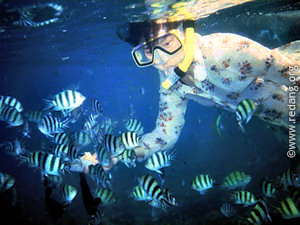
Feeding the fishes at the Marine Park Centre.
For most visitors to Redang, one of the highlights of the trip is the opportunity to feed fishes by hand. Many resorts bring their guests to the Marine Park Centre where hordes of hungry reef fish eagerly wait for snorkellers to feed them bread. It is an enjoyable and memorable experience for many and appears to be a win-win situation for both visitors and fishes.
However, the issue of fish feeding continues to be a controversial and debated issue in many parts of the world. The Marine Park Regulations in Redang do not explicitly state anything about feeding fishes. In many locations elsewhere, fish feeding is restricted or prohibited, including the Egyptian coasts of the Red Sea, many locations in Hawaii and several National Marine Sanctuaries. In the Great Barrier Reef Marine Park, shark feeding is prohibited and fish feeding is allowed but only under permit and tight restriction. The states of Florida and Hawaii in the US ban marine wildlife feeding by divers, thus terminating 'interactive diving' and commercial fish-feeding dive tours.
The arguments for and against fish feeding are presented below, though these are presented usually within the context of organized feeding of large predatory fishes like groupers and sharks which do not take place in Redang. I leave it to readers and visitors to consider the points presented and decide for themselves whether they should participate in fish-feeding activities in Redang. Given that there are merits in both arguments, perhaps a reasonable compromise is to restrict fish-feeding in Redang to the Marine Park Centre, and to permit only the feeding of food deemed suitable for consumption by the reef fishes.
Conservationist view
- Feeding unnatural food to marine life will harm them because they are not equipped to digest or process such food. Excessive carbohydrates are known to be unhealthy for marine fishes.
- Feeding disrupts normal feeding patterns and affects natural behaviour. It leads to a reduced ability to capture natural food, makes fishes dependent on people and lose their natural wariness of people, leading to more aggressive behaviour. The U.S. National Park Service banned the feeding of wildlife in all areas under its jurisdiction, including underwater areas in Hawaii, the U.S. Virgin Islands and Biscayne Bay due to scientific evidence supporting these claims.
- Feeding can be dangerous especially when large animals like sharks, big groupers and giant moray eels are involved. Although no fatalities have occurred, divers have been injured, sometimes seriously, while feeding (though not in Redang).
- Feeding upsets the natural ecology of the area especially when large predators gather in a particular area waiting to be fed and end up reducing stocks of fish in that area.
- Feeding promotes unnatural aggregation of fish species and can skew data collection of fish species and their numbers.
- Feeding can result in litter ending up in the sea in the form of food plastic bags left behind.
Pro-feeding view
- Marine animals are opportunistic feeders. The small amounts of food fed does not foster dependency on humans. In Redang, feeding is limited to the non-monsoon months and fishes need to forage naturally during the monsoon season.
- Feeding has educational benefits for participants and observers. They learn to appreciate the beauty and diversity of marine life, care for them and become strong supporters of marine conservation.
- Feeding creates close bonds between people and animals and can be therapeutic, helping to relieve stress and lower blood pressure in people.
- Feeding is safe with no known human participant fatalities.
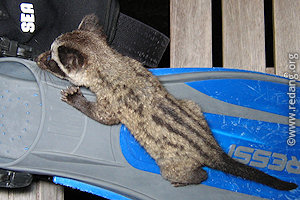
Baby civet cat, one of Redang island's natural inhabitants.
The most common animals encountered in Redang (other than bugs and creepy crawlies) are macaque monkeys, squirrels and monitor lizards. There are no large animals on Redang, and there are no legislations governing the feeding of wild animals. Just do so at your own risk but we strongly caution against feeding the monkeys (see below). Also, please remember to dispose leftover or uneaten food properly so as not to litter and attract pests.
Do not feed the wild monkeys!
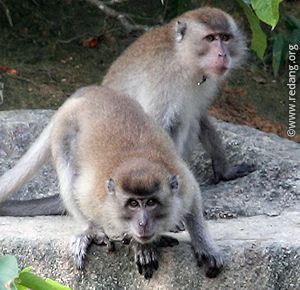
Do not feed or taunt the long-tailed macaque monkeys as they can be aggressive. These monkeys are usually seen in troops at the edge of the forests surrounding the resorts and along trails. Visitors staying in garden view rooms by the edge of the forests should take care not to leave windows or balcony doors open when they leave their rooms, especially when they have food inside. Feeding them breeds boldness, causing them to venture close to resorts and humans in expectation of food, and they become a nuisance when they harass people or steal your personal belongings.